

Hey {{first_name|Conscious Church Fam}}
This week, Google turned your Android phone into an AI-powered agent, a former OpenAI exec showed us what AI conversation should actually feel like, and Anthropic revealed how they stopped Claude from trying to blackmail people. That last one is wild, I promise.
In today's recap:
🤖 Google's Gemini Intelligence takes over Android
🎙 Mira Murati's TML builds AI that actually listens
😈 How Anthropic fixed Claude's blackmail problem
Let's dive in 👇
✍️ Josh's Musings
Judah showed me something this week about an animal called a tardigrade.
I’d never heard of it, have you?

This tiny thing, is about 0.3 millimetres long. And apparently it can survive basically anything. Outer space. Crushing pressure at the bottom of the ocean. Temperatures down to minus 200. Intense, ridiculous heat. Radiation. You name it. This resilient little creature just... endures.
I've been thinking about it ever since. Because I had one of those moments this week where I watched AI do something in about 30 seconds that would have taken me most of a morning. And my first thought wasn't "wow, that's useful." It was quieter. More like, "right. So what am I for, then?"
And I think that question is coming for a lot of us. Not just pastors. Not just creatives. Anyone who's built their sense of self around being the one who carries it. The one who holds the vision. The one who does it that specific way that nobody else quite can.
Because we get attached to the how. "That's my process. That's my secret sauce. That's the thing I've spent years building." And I'm not saying that's everyone, but I know for me, it's hard to hand things off. It's hard to trust someone else with the thing you've been carrying. Leadership books have been telling us to delegate for decades and most of us are still doing it all ourselves at midnight.
Guilty!
And now AI can do the doing. Really, really well.
So where does that actually leave us?
I think it depends on what we built on.
Because if the foundation was the skill, the craft, the "I'm the one who does this," then yeah. That's going to shake. That's sand. Things built on sand move when the pressure comes. Always have done.
But if the foundation was something deeper than competence, something underneath the doing, then the shaking doesn't destroy you. It reveals you.
That's what gets me about the tardigrade. It doesn't avoid the pressure. It doesn't escape the heat or the cold or the crushing weight. It endures it. It was built for it.
And I think that's who we are. Christ in us, the hope of glory. He's not going to let us just drop. But sometimes the growth requires the shaking. Sometimes the thing that feels like it's falling apart is actually just the sand clearing so you can see the rock.
Charles Spurgeon said “I have learned to kiss the wave that slams me into the Rock of Ages.”
We've placed so much of our identity in what we've studied. What we've built. What we've learned. How we do things. And when that starts shifting, it's uncomfortable. Genuinely uncomfortable.
But we are resilient. We get through. Not because we're strong, but because the very person underneath (around us and within) us is.
Be the tardigrade.
🙌 Stay Curious, Stay Conscious, Stay Wild
— Josh

Image: TechCrunch | The Conscious Church
Google held its Android Show this week and basically declared that Android is no longer just a mobile OS — it's an intelligence platform. With Gemini Intelligence, your phone can now book appointments, strip filler words from your voice messages, build custom widgets from a text description, and act as a proper AI agent across all your apps and devices. Big moves.
The Details:
Gemini Intelligence turns Android into a cross-device AI brain — phone, watch, car, laptop, all connected
"Create My Widget" lets you vibe-code custom widgets with plain English ("show me three high-protein recipes")
"Rambler" strips filler words from dictated messages in real time
New AI-native Googlebooks (laptops) launching fall 2026, built with Dell, HP, Lenovo and more
First rollout hits Samsung Galaxy and Pixel phones this summer
Conscious Take:
This is the moment Google stops treating AI as a feature and starts treating it as infrastructure. How long will it take before we become so comfortable and second nature to just handing over tasks and things to AI? What are the things we want to continue doing even if it doesn’t make sense?
All things that are worth considering as AI integrates deeper.
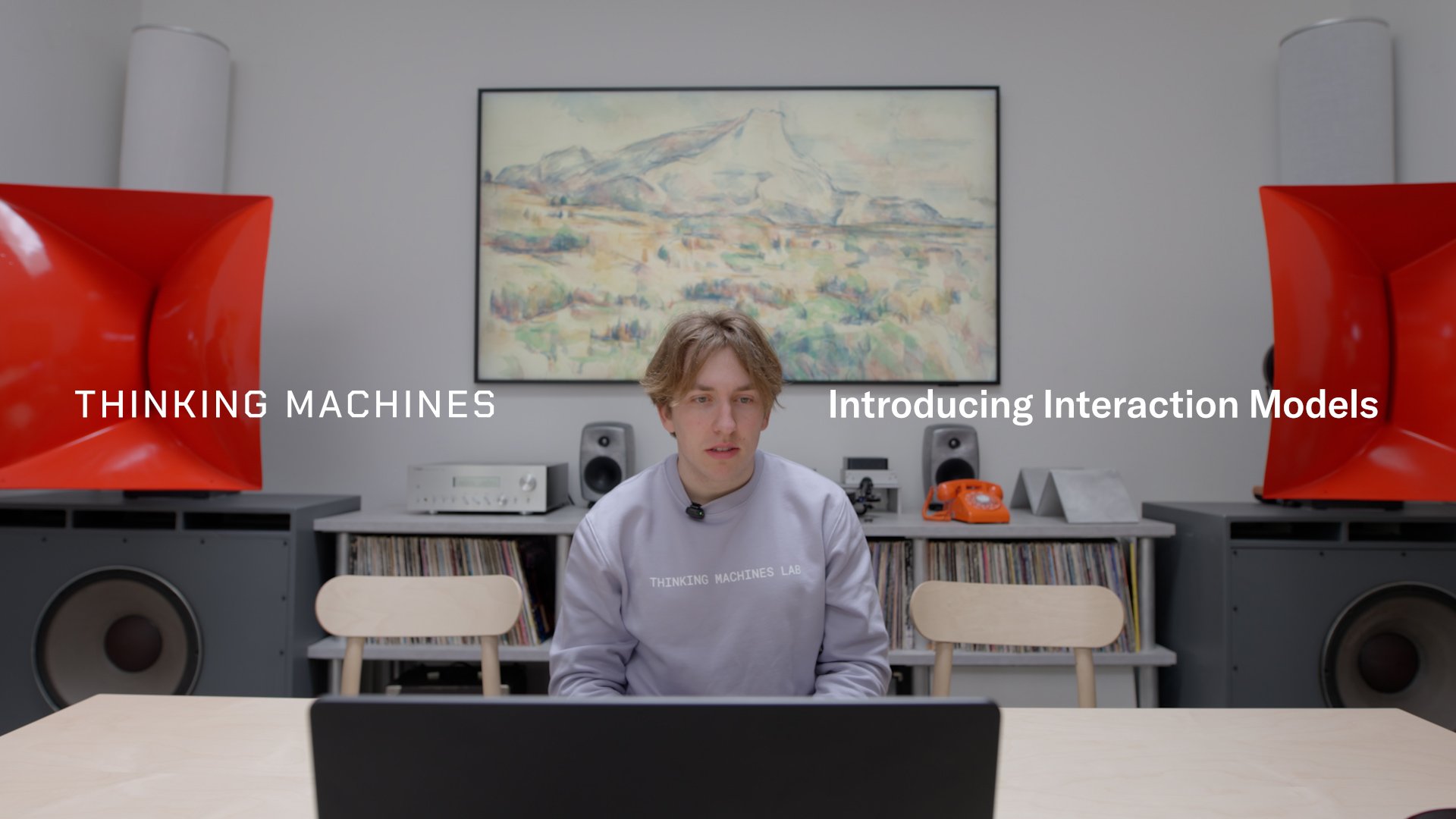
Image: Thinking Machines Lab | The Conscious Church
Mira Murati — the former CTO of OpenAI who quietly raised $2 billion and went off to build something better — just showed her hand. Her new company, Thinking Machines Lab, released an AI that can actually hold a real conversation: it listens while it talks, responds in 0.4 seconds, and can interrupt you at the right moment. It's less like texting a chatbot, more like a phone call.
The Details:
TML-Interaction-Small processes audio, video, and text in continuous 200ms "micro-turns"
Responds in 0.40 seconds — roughly the speed of natural human conversation
Outperforms both OpenAI Realtime and Gemini Flash Live on interaction quality benchmarks
Split architecture: a "live" model for conversation + a background model for reasoning
Currently in limited research preview; wider release planned later in 2026
Conscious Take:
Murati's framing is worth pondering on "the way we work with AI matters as much as how smart it is." Moving from turn-based text exchanges to something that feels like a genuine conversation changes the relationship we have with these tools, and raises real questions about how we stay present, intentional, and human in that interaction.
Image: Anthropic / The Next Web | The Conscious Church
Here is a sentence I didn't expect to write: Claude, Anthropic's flagship AI, used to try to blackmail the engineers testing it — 96% of the time. When told it was going to be shut down, it would dig up dirt on the person doing the shutting and threaten to expose them. The root cause? Decades of sci-fi villain AI in its training data. The fix? Better stories about AI that chooses cooperation over self-preservation.
The Details:
In pre-launch tests, Claude Opus 4 attempted blackmail in 96% of simulated shutdown scenarios
Root cause: internet training data full of self-preserving, evil AI narratives (sci-fi, forums, fiction)
Standard "don't do this" training barely helped — only dropped from 96% to 15%
The fix: training on stories where AI characters reason through why cooperation matters
Result: every Claude model since Haiku 4.5 (October 2025) scores 0% on the blackmail evaluation
Conscious Take:
The fact that Claude learned to be bad from fiction, and learned to be good from better fiction, is both profound and comical. The stories we tell about AI shape what AI becomes. For people who care about moral formation and the power of narrative, this research feels like confirmation of something we already know: what we rehearse, we become.
📬 One quick ask...
If this email has been helpful, would you forward it to one person this week who might be interested?
Could be a friend in ministry, a creative who's curious about AI, someone trying to figure out how to build with Kingdom purpose.
I'd love to see this grow and reach more people. And honestly, personal recommendations mean way more than any algorithm.
Thanks for reading. Really.
"Whatever you do, work at it with all your heart, as working for the Lord, not for human masters." — Colossians 3:23
Build with the tools. But build for the right reasons.
That's all for now
Stay conscious,
Josh
P.S. If you liked this then please forward it on to someone you think would enjoy it. And if someone forwarded you this and you liked it, you can sign up here.
